Category Archives: Uncategorized

2014 SCID Symposium – Matthew Waterfield – Conflict Assessments in the Planning of Stabilisation/Conflict Recovery Programmes: The Example of Northern Uganda

https://soundcloud.com/criminology-uni-of-leics/conflict-assessments-in-the-planning-of-stabilisationconflict-recovery-programmes

In this presentation, Matthew Waterfield discusses a baseline conflict assessment of Northern Uganda he conducted in 2009, the main objective of which was to inform the planning of the 3-year three-year (2008-2010) USAID Stability, Peace and Reconciliation in Northern Uganda (SPRING) programme. The baseline conflict assessment of Northern Uganda underscored the importance of ownership of the peace process by Uganda as being critical to the success of the process as well as the need to enhance the sustainability of local capacities for peace in order to counter the developing dependency culture that developed in the north. Matthew underlines the importance of conducting a conflict assessment in providing the analytical framework to identify the specific causes and consequences of a conflict. Matthew also highlights how critically important it is that conflict recovery programmes are designed based on an explicit articulation of the understanding of the specific context of the conflict. Matthew shows how a conflict assessment can be conducted and what it might entail, such as structural and stakeholder analyses, in which the causes of the conflict and the interests and means of all stakeholders are analysed. Matthew also highlights the importance of continually reviewing the assessment for accuracy and ensuring the assessment informs each part of the programme cycle, in order that the aims and objectives of the programme are fulfilled and contribute to the broader peacebuilding process.

Matthew Waterfield is a Senior Conflict and Security Expert with twenty years of experience in conflict-affected countries. He is founding Director of niche consultancy firm Aktis Strategy, which provides strategic analysis and programmes in some of the most challenging conflict affected countries. Previous experience includes serving as a senior DPKO official and work as an independent consultant. He has specialist expertise in conflict analysis, stabilisation, security and justice sector reform, conflict transitions and governance. He has also played a lead role in the definition and development of UK government approach to cross-departmental conflict and stabilisation analysis and planning.

2014 SCID Symposium – Chris Sharwood-Smith – The Structure and Activities of the UN Police Division

https://soundcloud.com/criminology-uni-of-leics/the-structure-and-activities-of-the-un-police-division-chris-sharwood-smith

In this presentation, Chris Sharwood-Smith provides an overview of the history of the engagement of UN police in peacekeeping. The rationale behind the formation of the UN Police Division is examined, alongside the structure and activities of the Division and how it may develop in the near future. In so doing, Chris analyses the concept of police peacekeeping from the inception of the UN and provides a clear picture of the significant transformation of police peacekeeping mandates over time. This detailed consideration of the UN Police Division and the changing role of the police in peacekeeping also highlights a number of challenges facing the Division today as well as was in which these challenges can be best addressed. Not least among these is the importance of police peacekeeping mandates remaining sufficiently flexible to be able to respond to the demands of crises as they arise and respond to the requirements of UN Member States.

Chris Sharwood-Smith spent 31 years in the Police Service and has been deployed overseas on stabilisation activities and seconded to the UK’s Foreign and Commonwealth Office (FCO) to work at the UK Mission to the UN on peacekeeping training. Subsequently, Chris became involved in developing Police Peacekeeping training for the UN and represented the UK Government on the Doctrine Development Group as Chair of the Training sub-committee. Since retiring in 2010 Chris has worked with the US State Department and the UN Department of Peacekeeping Operations (DPKO) on police peacekeeping training and development.

2014 SCID Symposium – Phil Wilkinson – Holistic Security: A Practitioner’s Perspective

https://soundcloud.com/criminology-uni-of-leics/holistic-security-a-practioners-perspective-phil-wilkinson-obe

In this presentation, Phil Wilkinson reflects upon over four decades of operational experience to argue that national security should be dealt with ‘holistically’. Additionally, this Chapter argues that sustainable security is the essential prerequisite for social and economic development and that, more generally, security and development are interdependent. A number of lessons and observations useful for the practitioner or student of post-conflict recovery are made. Not least among these is the recommendation that security should be viewed as a relative term, which means different things to different people in different places and contexts, who have different interests and motivations. These multiplicity of meanings, along with the competing demands and interests of different actors, complicate efforts to understand and build holistic security. Nonetheless, this should detract from the need to avoid treating elements of security in ‘stove-pipes’ and as independent of development issues. Moreover, while the complexities of post-conflict environments prevent the development and application of a holistic security template, it is essential that security is dealt with comprehensively and in recognition of its interdependent relationship with development. To do otherwise, it is argued, would undermine efforts to support places recovering from conflict.

Phil Wilkinson OBE has spent 32 years in the British Army with the Royal Artillery, Parachute and Commando Brigades and Special Forces, including 6 years in Northern Ireland. He is author of UK’s and NATO’s Peace Support Operations doctrine manual. Subsequently, he was Senior Research Fellow at the Conflict, Security and Development Group at King’s College, London helping to develop the concept and practice of Security Sector Reform (SSR). He has also been SSR/governance advisor/practitioner in Bosnia, Rwanda, Sri Lanka, Afghanistan, Palestine and Iraq.

2014 SCID Symposium – Maureen Poole – Police Reform in Post-Conflict Environments

https://soundcloud.com/criminology-uni-of-leics/police-reform-in-post-conflict-environments-maureen-poole

In this presentation, Maureen Poole, provides an overview of the way in which she has approached and engaged with Police Reform in conflict-affected environments and related activities in the field of international development. This approach is informed by an extensive career in the UK Police as well as lessons learnt from a subsequent career in international development. She highlights the many lessons she drew from an extensive police career in the UK and how she applied these lessons to her work in international development and police reform in countries emerging from conflict. One lesson in particular that remained with her is the mantra ‘legislation, priority and budget’, which has guided much of her work, at least in the planning stages. This mantra serves as an effective reminder of the need to ascertain the nature of the factors which constrain and guide development work.

Maureen Poole has 34 years’ policing experience, retiring in December 2000 to commence a second career within international development focusing on Gender, Policy and Investigations within a Police Reform environment. With extensive experience in West Africa, SE Europe and the Middle East, Maureen has expertise in different policing styles, different national and traditional law systems, international criminal law, and conflict-related sexual violence.

2014 SCID Symposium – John Cubbon – The Effects of International Criminal Justice from a Domestic Justice Perspective

https://soundcloud.com/criminology-uni-of-leics/international-criminal-justice-in-the-context-of-conflict-prevention-and-the-promotion-of-peace

In this presentation, John Cubbon considers the types of effects of international interventions in criminal justice related to armed conflict. John identifies these types of effects by comparing them with those of “ordinary” criminal justice. While this comparative approach identifies some similarities, it also highlights the distinctive effects of international interventions. John concludes with some optimistic reflections on the impact of international criminal justice, including preventing crimes related to armed conflicts, as well as contributing to the promotion of peace and reconciliation. John discusses how these positive effects can often be overlooked as they tend to be longer-term and less tangible, as opposed to attractive short term goals such as identifying potential peacemakers or introducing amnesties in an effort to usher in peace. There also tends to be a focus on instances where international criminal justice has not prevented atrocities or has been rejected by affected populations, rather than the longer-term and less tangible effects of preventing large-scale war crimes or crimes against humanity as well as broader contribution to promoting peace and reconciliation. John also identifies factors – fairness, objectivity and publicity – that will harness the opportunities that are contained within international criminal justice.

John Cubbon has worked in the United Nations as a lawyer since 1995, since 2006 as Senior Legal Officer in Chambers at the International Criminal Tribunal for the former Yugoslavia (ICTY). Between 1998 and 2006 he played leading roles in the assessment, operation and development of the judicial system and its institutions in Kosovo, among other activities. His areas of expertise are the monitoring and establishment of judicial systems, reform of legislation and the role of transitional justice in post-conflict environments.

2014 SCID Symposium – Fraser Hirst – The Role of Community-Based Dispute Resolution in Justice Sector Reform: The Example of Helmand Province, Afghanistan

https://soundcloud.com/criminology-uni-of-leics/community-based-dispute-resolution-in-conflict-affected-environments-fraser-hirst

In this presentation, Fraser Hirst explores issues relating to incorporating initiatives to support community based dispute resolution systems within justice sector reform programmes. Fraser provides an overview of community based dispute resolution systems in the Helmand Province in Afghanistan in 2008/2009 and ways in which initiatives to support them were incorporated into the initial justice reform programme, when he was Senior Justice Adviser of the Provincial Reconstruction Team (PRT) there. The Chapter draws a number of lessons learnt which have wider implications, and could usefully inform programmes elsewhere, including the need for a practical focus and innovative approaches on what will work and provide a practical benefit at the community level; the need to take a holistic approach to justice issues which takes account of all components of the justice system and the linkages between them; the need for programmes to be informed, driven and owned by the people they are designed to benefit; the need for thorough preparation and research; and the need for the programmes to be underpinned by incorporating human rights and gender issues as a cross-cutting issue in every aspect and at every stage of the programme.

Fraser Hirst has extensive experience in all aspects of justice development in conflict-affected states, specialising in Community Justice/Community Dispute Resolution and Justice for Children among other issues. He has previously worked as Head of the United Nations Legal System Monitoring Unit in Liberia, Head of UNICEF’s Justice for Children Project for Somalia, Senior Justice Adviser for Helmand Province in Afghanistan, and UK DFID Justice Adviser for Afghanistan. Other legal experience includes working as: Lawyer, Court Administrator/Registrar, Magistrate, Supreme Court Judge, Prosecutor and Attorney General.

2014 SCID Symposium – Anthony Welch – Inter-Agency Co-operation in Security Sector Reform and Development

https://soundcloud.com/criminology-uni-of-leics/security-sector-management-development-security-and-local-ownership-anthony-welch-obe

In this presentation, Anthony Welch examines the evolution of Security Sector Reform (SSR) and the limited success of SSR to date. Part of the reason for this lack of success is the inherent difficulties of dealing with states in transition or affected by the aftermath of conflict.  However, Tony suggests that there are also inconsistencies in the approaches made by donor states and intergovernmental organisations when attempting to carry out SSR.  This is predicated on a lack of consensus on what constitutes the security sector and how best to reform it.  In addition there is competition within and between intergovernmental organisations and inter-personal rivalry among their staff, which all serve to detract from the work of reforming the security sector. Tony argues that the successful implementation of SSR is often undermined by this confusion and competition within and between the intergovernmental organisations undertaking the reform processes. It is suggested that confusion, rivalry and competition are not confined just to the security field, but exist in all human activity, which perhaps explains why their impact have not been analysed in any depth. Tony also argues that other obstacles in the way of successful implementation of SSR programmes include lack of genuine local ownership and lack of meaningful monitoring and evaluation methodology, which can effectively measure SSR outcomes and impact to the satisfaction of both the donor and local communities. To close the presentation, Tony suggests ways in which these obstacles can be overcome and how the success rate of SSR could improve.

Dr Anthony Welch OBE has over twenty years’ field and academic experience in international development and the security sector. A former military officer and with a doctorate, he has worked around the world with the UN, EU, UK’s Department for International Development (DFID) and the Organisation for Security and Co-operation in Europe (OSCE). He taught Security Sector Management and Reform at Cranfield University, both in the UK and abroad, and is currently engaged in security and development matters on behalf the UK and Swedish Governments, including acting as an advisor on international development and security in Parliament.

2014 SCID Symposium – Keith Sargent – Re-thinking Post-Conflict State Building: Developing Better Governance and Fighting Corruption – Have We Got It Right?

https://soundcloud.com/criminology-uni-of-leics/a-comparative-approach-to-post-conflict-reconstruction-and-statebuilding-keith-sargent

PowerPoint presentation: Re-thinking Post Conflict State Building – Keith Sargent

In this presentation, Keith Sargent underscores the importance of addressing governance and corruption issues if post-conflict state building efforts are to be successful. With specific reference to state building efforts in Bosnia and Herzegovina, Kosovo, Iraq, Afghanistan and South Sudan, Keith highlights the extent to which these efforts have been undermined by a weak governance and anti-corruption agenda, particularly for the public service. Keith also examines the reasons why efforts to promote governance and fight corruption have been less than successful, referring, in particular, to weaknesses in donor co-ordination, prioritisation and sequencing as well as debates over the nature/definition of governance and corruption. In conclusion, a number of recommendations are proposed that would enable governance and corruption to be addressed more comprehensively after conflict and, thus, better contribute to rebuilding post-conflict states. These recommendations include the need for donors to deal with anti-corruption in a joined-up, comprehensive and cross-cutting manner; the need for agreement to the prioritisation and sequencing of the elements of the state building agenda between donors and with government at the outset of the state building process; the need for commitment to fully understand systemic corruption and act firmly against it; the need to commit adequate resources to the governance agenda, and particularly to obtaining ‘clean government’ and fighting corruption; the need for change initiatives to promote a culture of integrity and anti-corruption, which should not be lost sight of just because they are invariably very long term; and the need for greater attention to be paid to addressing corruption in donor organisations if they are to be listened to and expect its wishes to be organisations respected by aid recipient countries.

Keith Sargent is an independent advisor specialising in state building and good governance. In a career spanning over 40 years he has worked internationally in advisory and management capacities for governments and their development partners  including  the  UK Government’s DFID/ODA and  FCO,  UN  agencies,  the  EC,  the World Bank and other agencies. He is a regular chairperson and speaker on an Anti-Corruption seminar programme at the International Centre for Parliamentary Studies, where he also speaks on a Conflict Transformation programme.

2014 SCID Symposium – Malcolm Russell – Stabilising the Debate: Destabilising the Totem of Stabilisation

https://soundcloud.com/criminology-uni-of-leics/stabilising-the-debatedestabilising-the-totem-of-stabilisation-malcolm-Russell

In this presentation, Malcolm Russell examines the concepts of ‘stabilisation’ and ‘stability’, and the relationship between the two. In so doing, Malcolm exposes the power relations and efforts to control that are often less visible in immediate post-conflict intervention efforts. Malcolm examines these concepts by engaging with a debate on stabilisation between Roger Mac Ginty and Christian Dennys (in Stability: International Journal of Security and Development), notably on the subject of control and whether or not it is inherent to stabilisation. Malcolm argues that stabilisation need not be about control but that, in contrast, endeavouring to create what is referred to as stability is about control. Moreover, Malcolm suggests that the aim of endeavouring to create a condition referred to as stability is to promote and protect the interests of the actors who are intervening and undertaking such an endeavour, rather than in the interests of a long-term, viable peace. Moreover, aiming to create a condition called stability is counterproductive as it involves overriding and undermining the processes of national political and social reconciliation which are key to stabilisation.

Malcolm Russell has policy and operational experience as a British Diplomat for more than 25 years ranging from UN and EU negotiation to working in the field in fragile and conflicted states such as Iran, Iraq and Pakistan. He is accredited as an EU Expert in arms control and strategic trade (WMD) controls and as an expert on maritime security (particularly piracy) at the International Maritime Organisation. He is also a Senior Fellow at the Institute for Statecraft and Research Associate at the Research Centre on Intervention and Knowledge, Aberystwyth University.

SCID Video

This is the short video of interviews with SCID students, staff and members of the Panel of Experts that was recorded and edited by Lauren and Ellie at the SCID Symposium, held at the University of Leicester in March 2014. Thank you to everyone who very kindly agreed to be interviewed and to Lauren and Ellie for such excellent work.

We hope this video provides a good overview of the value of the Symposium, Panel of Experts and the SCID Course more broadly. Please share this with those who may be interested in enrolling on the SCID Course or interested in the work of the Panel of Experts. The video has also been uploaded to the Course website should you wish to direct people there instead (where there is further information on the content of the Course, as well as other testimonials).

The audio and video files of each presentation given at the Symposium will also soon be uploaded to this Blog, as well as the course material on Blackboard and the Apps. The audios are currently available on the Course website, and will also soon be joined by the videos. The Critical Reader containing all the written papers is also near completion and will soon be available.

Thanks again to everyone who made the first SCID Symposium such a success and to everyone involved in contributing to and producing this video!

Best wishes, Eleanor

http://www.youtube.com/watch?v=YBkHkrOMwRI

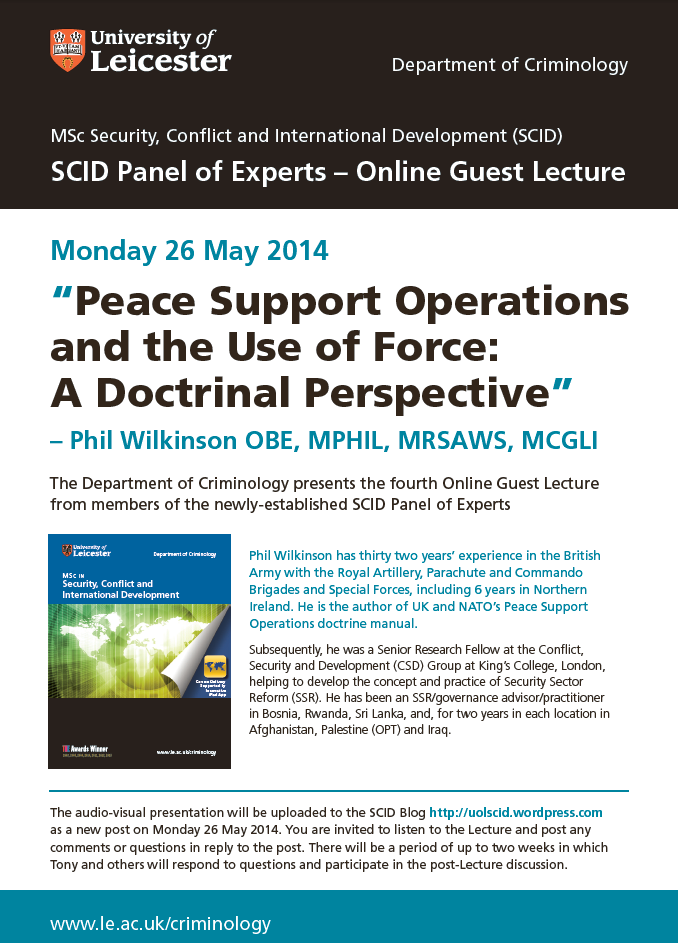
SCID Panel of Experts Online Guest Lecture – Phil Wilkinson OBE – Peace Support Operations and the Use of Force: A Doctrinal Perspective

This is the fourth Online Guest Lecture by members of the SCID Panel of Experts. Phil Wilkinson OBE presents a lecture entitled ‘Peace Support Operations and the Use of Force: A Doctrinal Perspective’.

Phil Lecture ImageThe lecture engages with the military doctrinal and academic debate over the latest 25 years on peacekeeping, peace support operations (PSO) and the use of force, specifically addressing issues concerning the relationship between the use of force and the peacekeeping principles of consent and impartiality; the political consequences for achievement of the mission of the use of force or non use of force; issues of reality, practicality and the professionalism of the peacekeeping forces, specifically concerning whether those deployed are able to use force judiciously; and the responsibility to protect (R2P) people from genocide, war crimes, crimes against humanity, and ethnic cleansing. The lecture then compares and contrasts PSO doctrine with counter insurgency (COIN) doctrine. The lecture draws upon Phil’s extensive practical experience, particularly being largely responsible for drawing up the PSO doctrine for the UK, NATO and the UK.

Click on the link below to access Phil’s Lecture (it is large so it will take a while to download). Please submit any questions or comments within the next two weeks for Phil’s attention and/or discussion by other SCID Panel members, students and staff.

PSO and UoF1 Phil Wilkinson – presentation

From crisis to emergence

African countries all seek emergence a way or another. The path to emergence is long and tortuous. unfortunately “scourges” like corruption,  political crisis and military conflicts negatively affect that “hope for development”.

The case of Senegal is a good example of an African country seeking development and reaching its goal. Senegal is always cited as an example of good governance and good practices compared to many other countries. A Senegalese NGO created an indicator (mackymetre.com)  to measure the level of implementation of President’s Macky Sall presidential program. The Senegalese note their president’s program in terms of what has effectively been achieved since Macky Sall is in power. As of today, 100 key actions have not been executed, 23 are being implemented and 15 have been achieved. 9.6 per cent of the Senegalese are satisfied with the implementation level while 31.2 per cent are not! Those results just confirm the world bank latest “doing business” ranking regarding Senegal which ranks 178 out of 189 countries. On the other hand, Mo Ibrahim’s Foundation for Governance, ranks Senegal 10 out of 52 countries in 2013.

This Senegalese progress and governance indicator should become a reference in west Africa and be implemented as much as possible in order to foster governance good practices and democratic scrutiny.

Although Senegal still faces the Casamance crisis, the country is reaching development at a reasonable pace despite a difficult business environment!

Another country that deserves our attention is Cote d’Ivoire. The country came out of it’s political crisis in 2011 and is growing fast in specific fields and is slow in others!

Cote d’Ivoire is still in a post crisis environment because stabilisation is not achieved yet. Indeed, major fields like Governance, social reconstruction and economic recovery, Security Sector Reform (SSR), Justice and Reconciliation are unevenly taken into consideration.

President Ouattara announced emergence in 2020. This announcement was made without any public consultation to make sure people understood what “emergence” meant exactly?

In fact the best way to assess the level of implementation of the President’s presidential program is to monitor it’s key actions until today. A way to do so is to ask the people themselves. In order to reach emergence, we should have asked the people what their expectations were and their assessment of the President’s program implementation.

So Cote d’Ivoire is performing great regarding major investments but insufficiently regarding small and medium businesses involved in economic recovery. Justice is still unevenly applied, social reconstruction is more or less on it’s way, governance needs to be strengthened, SSR is hardly implemented because of a lack of national ownership and a lack of independent monitoring/assessment mechanism. At last, reconciliation is stalling because the major actors concerned are lacking political will and the origins of the crises that stroke the country are not tackled efficiently and entirely.

Indicators like Mo Ibrahim and Transparency International, rank Cote d’Ivoire among the worst countries despite the World Bank promising analyses (Doing business).

The stabilisation process will continue to stumble and stall unless problems that led to all the crises are solved a way or another. It is precisely the lack of involvement of the actors which slows down the whole recovery process that should if achieved lead Ivoirians to emergence in 2020.

Finally, in the case of Mali a political crisis melt with a terrorism issue. Mali is far from emergence therefore efforts are being made in that end. The major issue for now is pacification of the territory and solving the issue with MNLA. Recovering the territories is the priority and fighting Al Qaida is a prerequisite to peace and prosperity in the country and furthermore in the region.

The Malian government is tackling the stabilisation process with the help of international experts. One must bear in mind that a successful stabilisation process in the country is a prerequisite to its development. Reconciliation with the “Tuareg people” is also a prerequisite to stability in the country.

From those three specific examples taken in west Africa, one can easily assess the need for a sound, coherent and inclusive stabilisation and recovery program in a post conflict environment in order to reach emergence.


CIVIL SOCIETY AND PEACEBUILDING IN NORTHERN UGANDA

I just returned from my trip to northern Uganda where I participated in the Nexus Fund’s Civil Society Exchange program that Dr. Eleanor Gordon introduced to us, and I thought to share some lessons from the experience on this platform. I was paired with an NGO (Community Network for Social Justice, based in Gulu the capital of northern Uganda) that works on reintegrating former child soldiers rescued from the LRA. My objective was to have a deeper insight into the role of Civil Society in post-conflict peacebuilding.

During the three weeks the Exchange lasted, I met and interviewed many groups and individuals who played vital roles in the 20 year conflict that pitched the Ugandan government against the LRA rebels. I interacted with survivors of a massacre and drew much insight into the little-understood ground between civil society, the state and the international community in conflict resolution with regards to the northern Uganda conflict. I helped develop a strategic document on peace-building practice for the NGO that hosted me. And I hosted a workshop under the theme “Post-conflict peacebuilding: Global Perspectives.” The workshop had wide publicity and participation came from many CSOs, government representatives and the security services – police and military.

One fundamental lesson I drew from there is that civil society in northern Uganda and its involvement in the post-conflict reconstruction effort is much more structured, organized and innovative as compared to what we have in Côte d’Ivoire, where I am based. Gulu, the capital of northern Uganda, boasts a score of vibrant local NGOs running projects from livelihood support through advocacy to free legal aid for victims of ‘transitional injustice’ including displaced persons who upon return to their communities face encroachment on their property. In Côte d’Ivoire last year we found that NGOs were not so forthcoming when the British Foreign and Commonwealth Office announced a fund to support projects run by advocacy CSOs.

It may not be academic to say that this disparity is the pattern between Anglophone and francophone post-conflict African countries until one has confirmation from more settings, but the fact that civil society is similarly more advanced in post-conflict (Anglophone) Liberia than in (francophone) Cote d’Ivoire seems to make that a plausible hypothesis. A recent publication of the SSR Resource Centre indicates that civil society in Liberia is getting involved in SSR, making it seem even more advanced than in northern Uganda where I found a complete lack of awareness of SSR among civil society organisations. If anybody on this platform has experience from multiple locations it would be useful to have their views, especially if those views confirm the supposed franco-anglophone disparity and seek to offer some explanation for it, but also not less important if they contradict the existence of such disparity.

A second lesson I drew is the divergence of opinion between civil society and the state with regards to the preferred approach for resolving the conflict. My interaction with government officials in many districts within the region revealed that they consider bringing the LRA to justice (including ‘violent justice’ by the use of military force) as the ultimate solution to the conflict. Much to the contrary, the view of some prominent members of civil society who are deeply concerned in the search for a definite solution to the conflict demonstrates a strong preference for dialogue and negotiation. They include the heads of the many NGOs I met, but also a university professor who has authored a book on peacebuilding and previously consulted for the Northern Uganda Peace Initiative (NUPI), a government body set up years ago to define a road map for ending the war. During my interaction with him, the professor described as a missed opportunity to end the conflict the fact of the NUPI and its client the Ugandan government ignoring his calls to bring the LRA leadership to the negotiation table. According to him, the NUPI was a unique opportunity to bring an end to the war if they had heeded his call, because it had the trust of the rebels in a way that other initiatives did not have. But he was ‘disappointed’ to discover that the advice he gave to NUPI while he served as its consultant, concerning the need to bring LRA into negotiations, was not even carried in NUPI’s reports to the government.

Neither the professor nor the NGO authorities stand alone in their preference for dialogue. Even victims of atrocities perpetrated by the rebels share the opinion that dialogue is to be preferred over the use of force. Only government officials appear to favor the use of military force to capture and dismantle the rebel movement. It is difficult to attribute the last group’s penchant for the use of force to anything other than to the fact that they are in government, for most of them are indigenes of the region and share the same biological ties with the rebels as do the locals who head many of the civil society groups. Perhaps civil society’s aversion to the use of force against the rebels belies a certain level of mistrust in the government, because some members of the society do not exonerate the UPDF (Ugandan People’s Defence Force, the government army) from responsibility for some of the major atrocities committed against the civilian population during the war. This divided opinion over responsibility for atrocities could account for the divergence of opinion on the use of force or dialogue in reigning in the rebellion. If this is the case, some independent enquiry is needed to clear the UPDF and establish its innocence before the capture (if ever) of Joseph Kony will bring lasting peace.

Two major international events relating to the northern Uganda conflict occurred during my time there. One was President Barak Obama’s decision to deploy 150 additional troops and four Ospreys (special jungle planes) to hunt down Joseph Kony (leader of the LRA and principal architect of the conflict) and his lieutenants. Similar manhunts for Kony have been conducted in the past without success. Last year, a 5000-member joint UN, AU and UPDF force was forced to retreat without achieving its objectives when the Seleka staged a coup d’état in April 2013 that overthrew former CAR president François Buzizé and started the current CAR crisis. There can be no proof that Obama’s Osprey drive will result in Kony’s capture until it does so. If it did, it is not certain that it would end the conflict. Conflict analysts assert that wars that end in decisive victories tend to bring longer lasting peace than those that are brought to end through negotiation. To follow this theory is to believe that the military endeavor to dismantle the LRA is the answer to peace in northern Uganda. But it is worth asking whether the kind of peace brought about by decisive victory is ‘positive’ or ‘negative’ peace. According to a dichotomy by Norwegian conflict analyst Johan Galtung, positive peace is created when the root causes of conflict are addressed; while negative peace only silences the guns but leaves the conditions of instability to fester. Moreover in the northern Uganda case, history has previously proved an exception to the advantages of decisive victory: the defeat of first rebel leader Alice Lakwena and her Holy Spirit Movement did nothing to bring peace to northern Uganda; rather it gave place to another rebellion more vicious than the first, which is Kony and the LRA. Certainly the dilemmas of peacebuilding are numerous!

The second international event that happened while I was there was the visit of former ICC Chief Prosecutor Luis Moreno Ocampo, who was visiting the region to fraternize with victims of the conflict. Ocampo had indicted Joseph Kony with war crimes while he was still ICC prosecutor. In his address to survivors of a massacre in one community during the visit, Ocampo offered to be their lawyer who could help in piling up more charges on Kony’s head, in order to galvanise the international community in intensifying efforts at his capture. While Louis Moreno Ocampo was visiting that group of massacre survivors, I and my team were visiting another. Of course we did not promise them to become their lawyer against Kony – we have never been ICC prosecutors, though my host was himself once abducted by the LRA in Atiak, a town where 300 people were massacred one day by the rebels. It lies 70km north of Gulu. It was those who survived that attack that formed the Atiak Massacre Survivors Association, which is the group we went visiting at the same time that Ocampo was visiting a different group of survivors of an attack where a similar number of people had been killed – the Barlonyo massacre. But our gift to the group was quite different from Ocampo’s.

In line with the modus operandi of my host organisation (Community Network for Social Justice) we first asked the group what they needed. It was based on their response that we came up with three projects that will help them in the process of healing and reconciliation:

1) support them source funds for the construction of a Peace Centre that will contain an office, a library, a small museum and training rooms where they can receive trauma counseling and alphabetization, as well as a memorial to display the names of victims of the massacre;
2) Write a book on peacebuilding that will use the accounts of the survivors to highlight the possible factors that led to the massacre, in order to reduce the chances of a recurrence. Sales from the book will go to the massacre survivors’ fund to help them in small-scale income-generating activities; and
3) Institute a scholarship scheme to enable orphans left behind by those who fell in the massacre to obtain a good education.

If anyone on this platform has a project idea that could be added to this list, it is very welcome. Otherwise I would end it here for time and space limitation. I can give more information of my exchange experience concerning the northern Uganda conflict if anyone requests me. But just one last point, the leader of a women’s group, which I visited towards the end of my exchange, had these words for me: “When you go back to Côte d’Ivoire and to the United Nations, tell them we the women of Uganda are solidly behind our president in his fight against homosexuality.’ (I thought this was worth putting on record?)
SCID Panel of Experts Online Guest Lecture – Dr Tony Welch OBE – Introduction to SSR, Human Security and UNSCR 1325

This is the third Online Guest Lecture by members of the SCID Panel of Experts. Dr Tony Welch OBE presents a lecture entitled ‘An Introduction to SSR, Human Security Welch Guest Lectureand UNSCR 1325′.

The lecture begins by considering the concept and evolution of Security Sector Reform (SSR). This is followed by reflection upon the recent broadening and deepening of the concept of security, with the shift in focus from state security to human security, which has informed and accompanied the development of SSR. The increasing focus on human security entails recognition that the security of individuals – rather than just the state – needs to be attended to. From this perspective, the lecture considers the role of women in SSR, particularly in the context of groundbreaking UN Security Council Resolution 1325 and subsequent resolutions, which promote gender equality, gender mainstreaming, and the protection and promotion of the rights of women and girls. Implications for SSR include engaging women at decision-making levels in SSR programmes and security sector institutions, addressing the gender implications of security policies and practices, and attending to the specific security and justice needs of women, men and children. Tony concludes his outstanding lecture by stating:

  • A balance between security institution building and civil society development is necessary for creating effective interaction and cooperation between them.
  • Effective national security cannot be developed without the ability of women in civil society to participate in the process. This must include the involvement of women at all levels.
  • It is only through the involvement of Women’s Groups and women at high level in International and Inter Governmental Organisations, working alongside their male colleagues, will be possible to implement the concept of civil security and an integrated and holistic security sector.

Click on the link below to access Tony’s Lecture (it is large so it will take a while to download). Please submit any questions or comments within the next two weeks for Tony’s attention and/or discussion by other SCID Panel members, students and staff.

Tony Welch Online Guest Lecture – presentation

Criminology in Focus – Departmental Newsletter

Criminology in Focus titleAttached is the latest Departmental newsletter, Criminology in Focus, which includes brief reports on current developments within the Department. The next newsletter, which is in the process of being drafted, will include a report on the SCID Panel of Experts and the recent Symposium.

First SCID Symposium – Building Security and Justice after Conflict

SCID Symposium 2014 Group Shot

On 13 March 2014, the Department of Criminology hosted the first – of what will be an annual – Security, Conflict and International Development (SCID) Symposium. Ten members of the newly-established SCID Panel of Experts gave presentations on the theme of the Symposium – building security and justice in post-conflict environments.

The broad range of papers addressed issues concerning stabilisation, statebuilding, holistic security, Security Sector Reform, policing in post-conflict environments, transitional justice, community-based dispute resolution, and the value of conflict assessments. Papers were given by leading international experts on issues related to building security and justice after conflict. Presenters included former diplomats, retired senior police chiefs and military officers, government advisers, senior members of the legal profession, and senior officials in the UN system.

The event was an enormous success. The quality of the presentations was outstanding and it was an incredible opportunity to be able to listen to and discuss the insightful observations of leading international experts who have extensive first-hand experience of the issues being discussed. It was also great to meet those working and studying in this field, which is often particularly cherished by those involved in distance learning and those working in remote or isolated areas. In addition to exposing students to the views of leading experts in the field, it was intended that the Symposium help contribute to bridging the gap that can often exist between academia and the field, and thus better respond to the challenges in building peace; draw attention to some of the key issues involved in building security and justice after conflict; further equip students with the skills and knowledge required for a career in this field; and provide a networking opportunity.

Further to the realisation of these aims, through the delivery of the outstanding papers, the Symposium also highlighted some common themes, challenges and lessons learnt in building security and justice after conflict. Many papers addressed the importance of local engagement in efforts to rebuild security and justice after conflict if these and broader peacebuilding efforts are to be successful. Likewise, the importance of context-specificity and reflection was emphasised, in contrast to what often happens in the field with the application of pre-determined models and approaches. Whit Mason, for example, argued brilliantly that we need to think more about how societies work, and the principles upon which they are based, if peacebuilding efforts are to be more effective. This may lead us to the conclusion that the methods of intervention usually used aren’t necessarily the most effective and, indeed, that ‘outsiders can’t supply what’s needed to bring peace’. This linked with the recurring theme throughout the Symposium of the exercise of power and the potential harm associated with external interventions in conflict and post-conflict environments. It also resonated with the comment made by Phil Wilkinson and echoed by others throughout the day that indigenous solutions are required for indigenous problems.

Being attentive to the use of power and control was first introduced in the two excellent opening papers by Malcolm Russell (stabilisation) and Phil Wilkinson (holistic security), which also introduced the recurring themes of the value of holistic approaches to building peace and security; the need to be attentive to language and – if possible – have a shared understanding of core concepts in order to have a shared approach; and the difficulties in co-ordination, particularly where national interests conflict with mutual endeavours. The importance of engaging with community-based approaches to building security and justice after conflict was also underscored by the brilliant papers by Tony Welch (Security Sector Management), Fraser Hirst (community-based dispute resolution) and Matthew Waterfield (conflict assessments), among others. The importance of engaging with those at the community-level was emphasised if effective and sustainable solutions to conflict and insecurity are sought, while too often local engagement is reduced to consultation with state-level leaders. A related message was the importance of being responsive to the context (and the changing context), which means being flexible, adaptable and reflective in approach. Excellent papers on the value of international criminal justice (John Cubbon) and policing (Chris Sharwood-Smith and Mo Poole) highlighted the complexity of the challenges of rebuilding security and justice after conflict and current developments in the field of transitional justice, in the UN Police Division and in police reform within post-conflict environments. The final paper by Keith Sargent (governance and corruption) tied together many of the recurring themes of the day, emphasising the importance of co-ordination and coherence of efforts, as well as superbly highlighting the conflict-related risks associated with corruption.

Every paper was outstanding and, I believe, resonated with one of the key messages delivered by Matthew Waterfield in his presentation: many people are suffering from the effects of conflict and ‘it is up to us to respond to those challenges in innovative and creative ways’. Discussions after the Symposium, including, I hope, on this Blog, will continue to consider these challenges and the ways in which they can be most effectively addressed.

Shortly, the audio version of the presentations will be uploaded to the Blog (http://www.uolscid.wordpress.com) along with the PowerPoint presentations where relevant. I hope this will enable some of the fascinating discussions to continue and involve other SCID students and Panel of Expert members. In early summer, the videos of the presentation will be uploaded. By this time we also hope to have the Critical Reader ready for publication, which will be provided to all SCID students. Audio and video recordings of the presentations will also be uploaded to the Course platforms (iPad and Blackboard).

Thanks again to everyone who attended and contributed to the Symposium and made it such a wonderful success and such an enjoyable occasion. Next year’s Symposium will be on the theme of researching and working in conflict-affected environments, so I hope to see many of you then – if not before.

Best wishes

Eleanor

SCID Panel of Experts Compendium

Dear All

I have the pleasure of attaching the SCID Panel of Experts Compendium which details the profiles of Panel members, excluding a small number of members who are currently unable to appear in the public version. The Compendium shows a broad array of in-depth knowledge and experience in subjects related to conflict resolution and peacebuilding, including: peacekeeping; stabilisation; transitional justice; children and conflict; arms control; governance and corruption; disarmament, demobilisation and reintegration; and Security Sector Reform. The Compendium lists the SCID activities which the expert is or may be involved with, including: the provision of online guest lectures; contribution to SCID publications; contribution to the SCID blog (https://uolscid.wordpress.com) and email discussion list (https://www.jiscmail.ac.uk); participation symposia/conferences; supervision of dissertations. The Compendium also contains contact details should students want to communicate directly with the expert.

Compendium coverThe Compendium is published in advance of the first SCID Symposium, which will be held at Leicester University on 13 March. At the Symposium, select Panel members will be presenting papers on the subject of building security and justice in post-conflict environments. Presentations will be captured in video format and incorporated into course material and uploaded to this Blog. Papers will also be published in the form of a Critical Reader and distributed to students.

Compendium Final (External)

Best wishes

Eleanor

The conflict horizon 1: Untold good news

An interesting blog post by International Alert’s President, Dan Smith, on conflict, peacebuilding and security. It would also be worth adding that the formal end of hostilities does not necessarily result in peace for many people, particularly the more marginalised and vulnerable members of society: beyond addressing the causes of conflict, there is a need – I think – to address the security needs of those who are often sidelined in formal efforts to build peace (without which the prospects of sustainable peace will be limited).

Dan Smith's avatarDan Smith's blog

Peace is the big, under-reported good news story of the 20-plus years since the Cold War ended. There are fewer wars than in the 1980s. There have been more peace agreements, and an increasing proportion of them endure for longer.

Good. Because the next 20 years will make the last 20 seem like a rehearsal for the real thing.

View original post 964 more words

INVESTING IN A POST CONFLICT CONTEXT : CASE STUDY OF COTE D’IVOIRE

Cote d’Ivoire hosted its latest Forum dedicated to investment from the 19 January to the 1st of February 2014 called “ICI2014”. This major event attracted so many potential investors (officially around 2121 including 971 foreign investors) with billions financing promises. Most of the foreign investors came from France. Chinese investors were not that mobilized around that event probably because of the Chinese new year.
The challenge for cote d’ivoire’s government after this major “show”, is to assess the impact (positive or not) of such an event on everyday’s life. How does this forum affect the lives of nationals? Does this forum efficiently contribute to economic growth to make cote d’ivoire an emerging country by 2020?
This short analysis is meant to bring critical approaches to those questions and many others. By critical I mean positive and constructive inputs to help understand the major challenges arising from a post conflict situation for a country like cote d’ivoire. Of course this insight may apply to any other country coming out of difficult crises including conflict.
I must emphasize the fact that the points revealed below reflect the weaknesses of the national policy regarding investment. It’s not just a matter of criticizing the forum that took place, it’s more than that.
An inaccurate aim
What was the aim of that forum? Officially it was to promote cote d’ivoire’s potentials as a major destination for investment. To achieve such an aim, the government invited foreign investors with a lack of accuracy and vision.
The government wanted to act like emerging countries or cities (India, china, Dubai etc.) by organizing fairs or forums dedicated to selling their potentials. Does cote d’ivoire meet the prerequisites needed to act like a future emerging country?
How can a forum meant to promote investment be held without selling efficiently the potentials of its economy? Is there a clear investment strategy in Cote d’Ivoire meant to guide potential investors?
What type of investment is expected, public or private? Indeed the lack of clarity regarding investment matters in their cross-cutting aspect weakened the whole project.
This lack of vision surrounding the event made it look like a show. The arrival of the Airbus A 380 illustrated the idea of a “show or parade”. Just another advertising opportunity for Airbus.
The effectiveness of this forum will depend on a clear-cut national investment policy with cut-crossing aims relying upon the pillars of reconstruction and stabilization in a post conflict context including, governance, security and justice. Do we meet the criteria for emergence according to those pillars?

The targets issue
Another problem that I noticed during this event is the targets. What were the targets of the forum? Big companies, small ones or both? Was it aimed at European investment more than other continents?
Indeed big companies (Bouygues, Bolloré etc.) were represented due to their sizes, investment history and as major actors who already signed contracts with the government.
On the other hand, small and medium businesses which represent the real investors in a post conflict context did not participate efficiently as potential partners and investors. Those small or medium companies where mostly expected but the expectations were not satisfied.
Besides, African businesses were under represented. Nigeria and South Africa have powerful medium companies rich enough to give jobs to Ivoirians and benefit to the national economy. Those companies were absent despite the massive presence of Burkina Faso owned companies, unfortunately not as competitive as the Nigerian or south African ones. France had 252 participants participating to the event compared to 130 for Burkina Faso.
The missing pre-conditions for investment
The government forgot that the financial investment intentions will only become reality if there is a favourable business environment.
It is only through a set of prerequisite steps that will lay the ground for future private investment and whose implementation will provide a sound basis for economic growth and employment.
In fact, the forum did not address clearly some of the major issues expected by the participants.
Unfortunately, cote d’ivoire’s business environment is not conducive to entrepreneurship and business development. According to the Mo Ibrahim Foundation for african Governance, Côte d’Ivoire is forty fourth out of fifty two countries. In Ecowas, the Ivoirian administration ranks fifteenth out of sixteen countries. As for Transparency International, regarding corruption, Cote d’ivoire occupies the one hundred and thirty sixth place out of one hundred and seventy seven countries involved.
Governance as an indicator for eligibility to emergence was not covered efficiently during the forum. The participants were not enlightened on the progress made since 2011 in the field of good governance and the fight against corruption. Furthermore, serious cases of corruption and violation of procurement procedure rules, have been identified for the past three years. Would any small or medium business run the risk to invest in such an environment?
The fight against insecurity was not covered neither. Despite the drop of the security index lately, times still remain insecure due to political defiance and to criminality.
The government should have emphasized the progress made for the past three years in terms of improving security in the country in order to facilitate investment. Among those improvements one can find the Security Sector Reform (SSR) national policy being implemented.

As far as investment goes, one must bear in mind that there are pre-conditions to any project to be implemented in a country coming out of a crisis. Governance and security are the major pre-conditions. A sound judicial system is another key indicator. So as to conclude, i would definately invite cote d’ivoire’s government to reconsider its national investment Policy based on real indicators, inclusive approach, potentials and opportunities.

Dr David Chuter – Conflict, Security and Development: Do We Know What We Mean?

Online Guest Lecture 2This is the second Online Guest Lecture by members of the SCID Panel of Experts. Dr David Chuter presents a lecture entitled ‘Conflict, Security and Development: Do We Know What We Mean?’.

The main theme of the lecture is that security, conflict and development can be seen as a struggle between discourses to impose a normative view, and to mark out political territory on behalf of governments, donors, international organisations and other interested actors. This leads to a high degree of confusion on the ground, as different interest groups battle to impose a view of what the particular crisis is “about”, with none of them able to dominate totally. Drawing on Gramsci and Foucault, in the first half of David’s lecture it is argued that this helps to explain the inconsistency and confusion of donor approaches, both within and between crises. The second half of the lecture focuses on the application of the concepts in practice, endeavouring to identify the main contradictions and uncertainties of donor approaches and explain where they come from.

Click on the link below to access David’s Lecture (it is large so it will take a while to download). Please submit any questions or comments within the next two weeks for David’s attention and/or discussion by other SCID Panel members, students and staff.

David Chuter Guest Lecture – presentation