Author Archives: uolscid

2015 SCID Symposium – Peter Reed – Creating Strategies for Security Sector Reform (SSR) in Volatile, Uncertain, Complex and Ambiguous (VUCA) Operating Environments

PowerPoint presentation: Peter Reed Presentation SSR for VUCA Environments

In his presentation, Peter Reed describes how , for many countries, reform and development of their security sector institutions is a constant iterative process – perhaps, just like a business, to preserve defensive capability and a competitive edge as cost-effectively as possible in the national interest. In post-conflict situations SSR becomes an imperative, and can take on an urgency that may be at odds with the complexity of the challenge and often constrained resources. Peter Reed suggests how the US military-coined ‘VUCA’ (Volatile, Uncertain, Complex and Ambiguous) acronym and Kotter’s 8 Stages for Leading Major Change can be applied to SSR and broader stabilisation interventions. Peter Reed draws on current examples of the challenges presented by highly complex operating environments in fragile and conflict affected States (with short case studies from Libya and Somalia).

Peter J. Reed is the Director and Head of Security Sector Development for WYG. He is an internationally experienced strategy, organisational development, and security sector development consultant, specialising in high level policy advice, policy and strategy development, strategic planning, organisational and institutional capacity assessment, leadership and senior management development. He has significant experience of the project leadership and direction of high value transformational change programmes in the UK and 40 transitional developing countries, and assessment of systemic, institutional and organisational capacity – particularly in complex, fragile or post-conflict environments. He is currently the Team Leader for the UK’s Libya Security, Justice & Defence Programme and is has been a Special Forces Officer.

2015 SCID Symposium – Douglas Brand OBE – The Challenges of Putting the Right People in the Right Place

In his presentation, Douglas Brand considers the adverse impact that not recruiting the right people can have upon the delivery of aid and development. Of particular consideration is the harm that results from conflict between those delivering aid or implementing development programmes, and those recruited to facilitate such work (such as those engaged in logistics, procurement, transportation and security). Douglas Brand explains that part of the reason for this conflict, and for underperformance in delivering aid and development programmes, is that those who are recruited and deployed can lack all but the technical skills for the job. What is required is pre-deployment and in-theatre training, as well as assessment of non-technical competences – including attitudes and cultural sensitivities – during the recruitment process for development professionals. Such non-technical competencies would include the attitudes, cultural sensitivities, behaviours, and beliefs of a potential actor as it has for the technical skills that the work requires them to have.

Douglas Brand OBE is a former UK Chief Police Officer and has extensive experience in international policing, security, stabilisation, and rule of law. Currently the strategic policing adviser to the National Police Service of Kenya, his recent engagements also include similar work for the Nigerian Federal Police, and directing leadership courses for senior officers of the Palestinian Security Forces in the West Bank. He has also been the Senior Police Advisor to the FCO working particularly on security sector reform, (SSR), projects in Africa and Afghanistan, and he was the Chief Police Adviser in Iraq, 2003-4. He is author of the European Union Manual of Guidance on Conflict Management for Police (2000), and has also published several articles on the challenges to rule of law that manifest themselves in International Peace Support Operations.

2015 SCID Symposium – Katharina von Schroeder – We Were Rebels – Film Screening with Director’s Introduction and Q&A

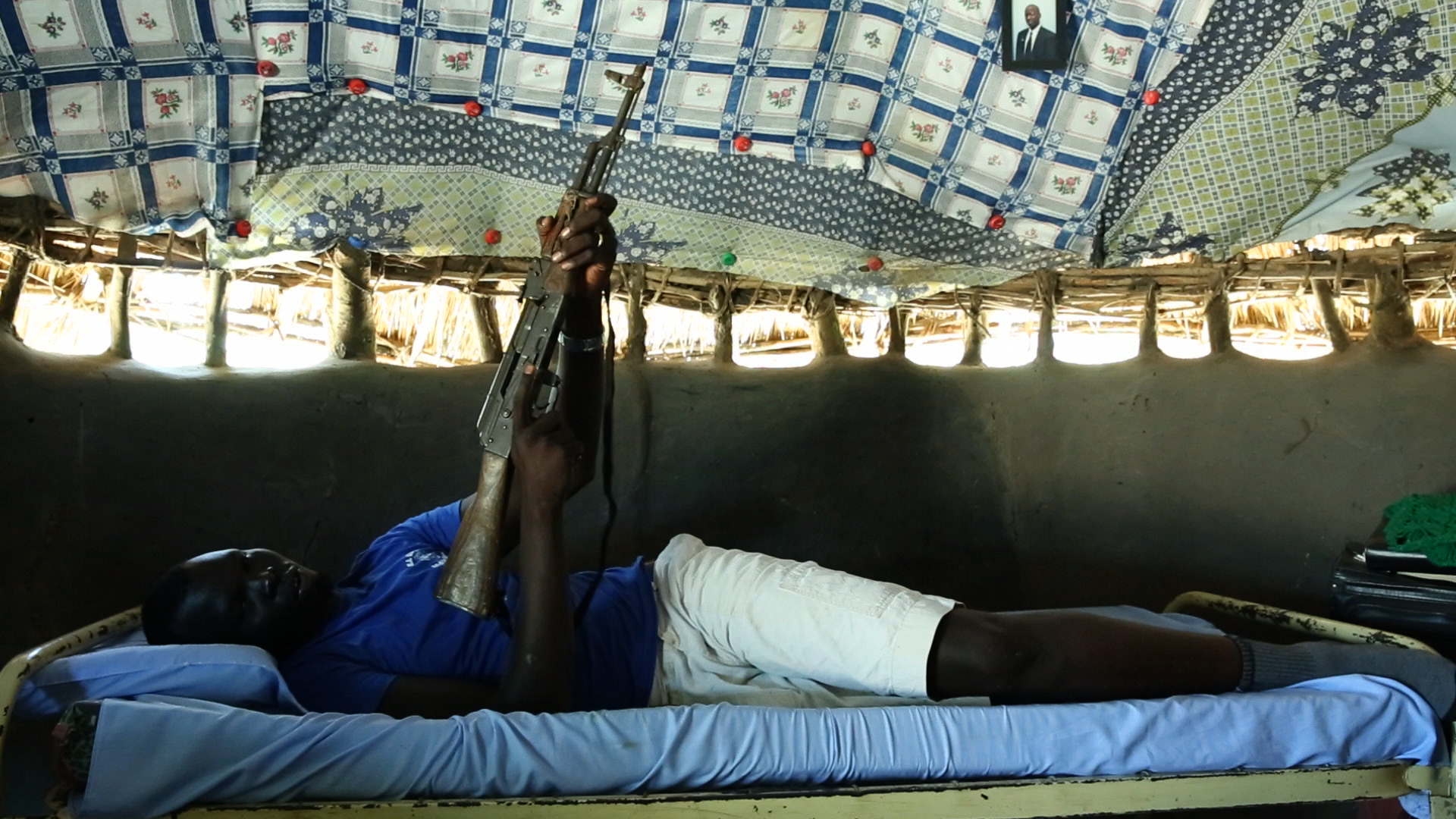
In her presentation, Katharina von Schroeder describes the challenges faced by a documentary filmmaker in researching, preparing for and filming “We Were Rebels”. The presentation also underscores the  significant amount of time needed to build trust and rapport, and the film demonstrated how complex phenomena, such as conflict or peace processes, can be shown through an in-depth study of a single person or place. The film is an award-winning feature-length documentary filmed over two years, which follows the trajectory of a young nation, South Sudan, in overwhelming euphoria from their recent independence until the outbreak of war in December 2013. The central character is Agel, a former child soldier turned basketball captain, who returns to his home country to help rebuild it after decades of war.

Katharina von Schroeder is a film director and current SCID Student. She completed her film studies at the Konrad Wolf School for Film and TV in Potsdam Babelsberg with the feature length documentary “My globe is broken in Rwanda“, which was shown at several festivals and won the Max Ophüls Preis in 2010. During and after her studies, she worked as an editor and author for independent productions, as well as TV stations including the BBC, ZDF, ARTE and Al Jazeera. She has directed a number of films, including “We Were Rebels” and “The Two Sudans”.

Syrian Refugees – BBC Interactive Resource & HCR Video

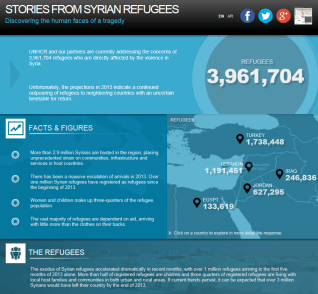
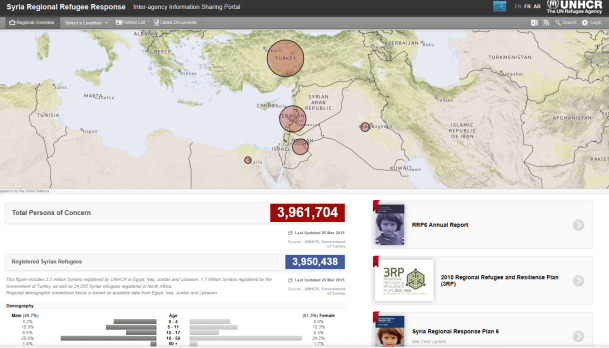
Syria RefugeesThe BBC website has a new interactive resource on Syrian refugees.

Also uploaded is a recent UNHCR video on people fleeing Syria to Iraq, as well as links to data and other responses on UNHCR-hosted inter-agency information-sharing portal (Syria Regional Refugee Response) and UNHCR’s webpage on Syrian refugees.

syria refugees 3

syria refugees 2

SCID 2015 Symposium

On 12 March 2015, the Department of Criminology hosted the second annual Security, Conflict and International Development (SCID) Symposium – Researching and Working in Conflict-Affected Environments.

IMGP4406Presenters included 11 members of the SCID Panel of Experts, including professors, retired senior police chiefs and military officers, government advisers, international human rights and humanitarian law barristers, senior officials in the UN system and other leading international experts in the field of conflict resolution and recovery.

The broad range of papers addressed issues concerning the challenges of conducting research and working in conflict-affected environments, and ways in which to improve practice; monitoring and evaluation of programmes; recruitment and deployment of staff; preparing police peacekeepers; managing multi-cultural teams and the importance of inter-cultural effectiveness; and ways in which to gather and utilise data. Specific subjects included the practical challenges of conducting police research in Kano (Nigeria); Security Sector Reform and development of the National Security and Stabilization Plan (NSSP) in Somalia; the relationship between food security and conflict in Mozambique, Burundi and elsewhere; election monitoring in Ukraine; the use of evidence in the monitoring and evaluation of programmes in Helmand (Afghanistan), Lebanon, Syria and Pakistan; and the use of biometrics and population registration in the Balkans.

AgelAlongside Panel members, SCID student and film director, Katharina von Schroeder, introduced the screening of her award-winning feature-length documentary film We Were Rebels, which follows the life of a former child soldier in South Sudan. Additionally, the SCID course developer and tutor, Eleanor Gordon, gave a presentation on bridging the gap between the worlds of academia and practice, with a view to better understanding and thus responding to the challenges of conflict and peacebuilding – tying into the theme of the Symposium and overarching aim of the SCID Course and the establishment of the Panel of Experts.

Matthew Waterfield opened the Symposium with a presentation on the use of evidence in the monitoring and evaluation of programmes in fragile and conflict-affected countries. This presentation underlined the importance, and challenges in the way, of gathering and using evidence in these environments and, in this context, suggested many innovative methods for the collection and use of evidence. Richard Byrne’s presentation considered the relationship between food security and conflict, before explaining the importance of military actors being aware of this relationship if stabilisation efforts are to be successful. This presentation then detailed ways in which to build this awareness and gather and share the requisite data. The presentations by Mathew Waterfield, Richard Byrne and others indicated the benefit that closer working relationships between academics and practitioners can have on peacebuilding efforts, not least in terms of the importance of gathering and analysing data in order to inform practice and thus improve performance and results.
IMGP4369IMGP4379Alex Finnen’s presentation addressed the challenges of working as well as researching in conflict-affected environments, the former with particular regard to technological and legislative developments in population control, such as free movement across boundaries. Likewise, Peter Reed’s presentation addressed the challenges of working in these environments, in the context of post-conflict Security Sector Reform (SSR), and ways in which these challenges can be best addressed, not least by developing strategic approaches and investing in leadership. Maureen Poole’s presentation also highlighted the challenges of working in these environments, with a specific focus on policing in Ukraine during 2014, with the compressed election preparation timeframe, unresolved conflict, large numbers of internationally displaced persons (IDPs), and high levels of crime and disorder. By drawing attention to challenges faced in these environments, these presentations reinforced the lessons that can be usefully learnt and applied to similar contexts.

There were many principles and lessons learned that were highlighted in the papers presented, which resonated across various fields of practice and research. The presentations of Anna Shevchenko and Alex Batesmith, in particular, highlighted the need for practitioners (and researchers) to be attentive to cultural dynamics; to recognise and respond to different cultural attitudes and needs; and to be culturally effective by developing and practicing good listening skills, and having humility and respect for others. Chris Sharwood-Smith and Douglas Brand highlighted the importance of being well prepared and trained in advance of deployment, and of identifying the right people to be deployed to the right places at the right time. This would be as applicable to those engaged in research as well as practice, of course.

IMGP4400Presentations by Douglas Brand, Chris Sharwood-Smith, Alex Batesmith and others demonstrated the role that employers have in contributing to effective peacebuilding by selecting, training and supporting people and in evaluating their performance. These principles can be applied to those engaged in conflict-affected environments beyond the police peacekeeper, lawyer and those working in aid and development – the focus of the presentations by Chris Sharwood-Smith, Alex Batesmith and Douglas Brand, respectively. These and other presentations also highlighted the importance of focussing on competencies beyond technical ability and knowledge when determining who should be recruited or engaged in a particular project. Oftentimes, compassion, empathy, motivation and commitment to making a positive contribution are overlooked during the recruitment and selection processes in favour of ascertaining the technical skills and prior experience someone may have, as highlighted in Douglas Brand’s presentation. As Alex Batesmith’s presentation suggested, it is skills such as the ability to listen, show humility and respect towards others, know oneself and the environment in which one works, and cultivate and demonstrate commitment to contributing to the host country that will determine project success. Related to this, Anna Schevchenko’s presentation also clearly highlighted the need to recognise and respond to the different skills and styles of different members of a team when allocating tasks, to avoid conflict and facilitate programme success.
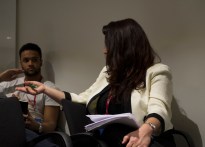
IMGP4387 IMGP4395 IMGP4383

Throughout the day it was clear that a number of lessons learned in various fields can be usefully shared between practitioners engaged in these fields. For instance the advice to develop cultural effectiveness of lawyers in Alex Batesmith’s presentation would seem equally useful to those working in the armed forces in peace operations or those employed as police peacekeepers. Likewise, those engaged in research in these environments can clearly benefit from some of the lessons learned by practitioners and highlighted in the presentations mentioned above, including the need to consider how to work in complex, multi-cultural, insecure and volatile environments.

Similarly, there are lessons that could be usefully shared with practitioners by those engaged in the field of research in conflict-affected environments, which were highlighted in the presentations by Alice Hills, on police research in conflict-affected environments, notably Kano in Nigeria; Tony Welch on the challenges of conducting research in conflict-affected environments, with a focus on SSR research; and Eleanor Gordon. These lessons include the importance of  determining what analytical tools to utilise and what information/literature to draw upon (and the importance of being aware of and reflecting upon one’s choices and how it will impact the research); reflecting upon the impact of the research process and output on the research participants and research environment; being aware of and addressing the power dynamics between researcher and research participant; and being familiar with the impact on research of the choice in gatekeepers, locations chosen for research, use of language, issues addressed/questions asked, and so on.

IMGP4392  IMGP4396  IMGP4398

Aside from common guiding principles and lessons that can be usefully shared between practitioners and researchers working in conflict-affected environments, lessons can be learned from others beyond the parameters of those directly engaged in or studying/researching building security and justice after conflict. Katharina von Schroeder’s film and presentation highlighted the need to spend a significant amount of time to build trust and rapport. Her presentation also resonated with the practical challenges of conducting research, particularly without any institutional support, that were highlighted by Alice Hills often constituting the most instrumental challenges to a research project: where to live while in a conflict-affected environment; how to get around; where to find an interpreter; and what to do in the event of a security incident or unforeseen development, for example. The film demonstrated how  complex phenomena, such as conflict or peace processes, can be shown through an in-depth study of a single person or place and, crucially, it captured the complexity and emotional content that can sometimes be missing in research or project outputs. Similarly, concepts, theories and approaches developed in other disciples may also add value to those engaged in conflict resolution or peacebuilding. For example, the way in which theories and strategies developed by the military can be applied in management, and vice versa, and further applied to others working in volatile, uncertain, complex and ambiguous (VUCA) environments, such as conflict-affected environments, was also detailed by Peter Reed.

In sum, there were common threads and recommendations running throughout the presentations, and principles highlighted in various presentations that are clearly applicable to all those working in any capacity in conflict-affected environments, including those engaged in research. These included the need to be responsive to ever-changing dynamics in post-conflict environments and be flexible with plans; to ensure actions are context-specific as well as informed by applicable lessons from elsewhere; to be aware of security risks (to self and those with whom we work or engage with) and take necessary action to minimise those risks; to avoid underestimating the amount of planning and preparation required; to take care when recruiting people (whether as practitioners or part of a research project); to show respect towards others and humility; to take time in the field (to build trust and rapport); and to listen, learn and be self-aware.

IMGP4386IMGP4385The event was an enormous success and gave SCID students, staff and Panel members the opportunity to discuss the challenges of conducting research and working in conflict-affected environments, and ways in which those challenges can be best met. The papers presented were excellent and the day couldn’t have been drawn to a close any better than with the screening of Katharina’s outstanding film and her presentation of the way in which she overcame the challenges of researching and working in South Sudan over the two-and-a-half year period in which the film was made. The opportunity to meet students and Panel members in person, rather than virtually, was also invaluable – and the social events were very enjoyable.

Thank you to everyone who participated in the Symposium and made it such a success. Please don’t hesitate to post further comments, questions and feedback to this Blog, including preferences for the theme for next year’s Symposium.

Papers from the Symposium will be shortly published in the Annual SCID Reader, which will be provided to all SCID students and uploaded to this Blog. Recordings of each presentation will also be uploaded to this Blog as well as linked to from the Course platforms (iPad and Blackboard). This will enable those who were unable to attend to watch the presentations and allow all of us to continue the discussions on how best to respond to the challenges of conducting research and working in conflict affected environments and, ultimately, how best to understand and respond to the challenges of conflict.

Best wishes, Eleanor


We Were Rebels

For those who didn’t have the opportunity to view the outstanding feature-length documentary film by Katharina von Schroeder (Film Director and SCID Student), We Were Rebels, at the recent Annual SCID Symposium, the following YouTube clip and film review may be of interest alongside the webpages of the production company and the film’s FB page: LSE Africa – Film Review.

The film follows the story of a former child soldier returning to South Sudan, spanning over 2 years from its independence in 2011 to the outbreak of conflict at the end of 2013. It is currently touring international film festivals and has recently won the prestigious German TV award ‘Grimme Preis’.

Katharina’s presentation at the Symposium on the challenges of researching and filming in South Sudan will soon be able to be watched on this Blog, and her paper will also be shortly published in the Annual SCID Reader.

In the meantime, I would strong encourage anyone to watch this film if they have the opportunity.

Call for Papers – Reflections on Revenge: an International Conference on the Culture and Politics of Vengeance

revengeReflections on Revenge: an International Conference on the Culture and Politics of Vengeance

2/3/4 September 2015, University of Leicester
Confirmed keynote speaker: Philippe Sands QC

‘…the sweetest morsel to the mouth that ever was cooked in hell’

The taste for revenge, whether morsel or dish served cold, is something people, groups and nations, and even animals desire. Since time immemorial, individuals and communities have done justice by harming those who have harmed them, despite the costs, and the avengers immortalised as heroes and villains. While the hurts and methods for addressing them may differ, blood feuds, the killing of Osama bin Laden, and revenge porn are all motivated by the need to get even.

This interdisciplinary conference will ask who seeks revenge and why, how it is done, how it is justified, how it is represented, how it feels to get revenge or be on the receiving end. This includes revenge starting with the smallest workplace slights, through family disputes and lynch mobs, to political violence, war and terrorism. We invite contributions, including those not in the academic paper format, from any area of biological, human and social sciences, arts and humanities, and more, that are related to topics including but not limited to:

  • interpersonal revenge, state revenge, collective punishment
  • technologies of revenge
  • revenge cultures, blood feuds, and informal justice
  • revenge, politics and world history
  • revenge, terrorism, armed conflict and retaliation
  • the personal and social costs of revenge
  • revenge, justice and injustice
  • revenge in art, literature and media

This is a multimedia event, and will be contributing to the production of a documentary on revenge by Rex Bloomstein and Justin Temple (RexEntertainment) as well as traditional academic outputs.

Please submit a 250 word abstract via email to revenge@le.ac.uk by April 2nd, 2015.

Institutional Logic and Security Threats

A very useful video to watch in the context of the start of the SCID course (considering where conflict may arise in the future and why) and the end of the course (critically reflecting upon the relationship between transnational security threats and conflict), the following is an excerpt from a presentation by Noam Chomsky who was joined in conversation by David Barsamian.

Annual SCID Symposium: Researching and Working in Conflict-Affected Environments (12 March 2015)

The Panel of Experts for the Security, Conflict and International Development (SCID) MSc Course, provided by the Department of Criminology, was established in order to further enhance the learning experience of students and expose them to the knowledge and views of a broad range of leading international experts in the field of conflict prevention, resolution and recovery. Eleven Panel members have been invited to the second Annual SCID Symposium in Leicester on 12 March to present papers on the subject of researching and working in conflict-affected environments. Alongside Panel members, the SCID course developer and tutor will present a paper and a SCID student and professional film-maker, will be presenting a recent feature-length documentary film she directed entitled We Were Rebels, which follows the life of a former child soldier in South Sudan

The theme of the Symposium ties into one of the core aims of the SCID Course and one of the main reasons for establishing the SCID Panel of Experts: to help bridge the divide between academia and practitioners in the field. This is particularly important given the Course aims to equip its students with the knowledge and skills to pursue or advance their careers in this field. Ultimately, it is hoped that by bridging the gap between academia and the field, efforts to understand and better respond to the challenges posed by conflict can be enhanced.

The broad range of papers address issues concerning the challenges of conducting research and working in conflict-affected environments, including: research ethics; monitoring and evaluation of programmes; recruitment and deployment of staff; police research; managing multi-cultural teams; how international lawyers can work more effectively with their national counterparts; preparing police peacekeepers; creating strategies for Security Sector Reform; food security and conflict; the use of biometrics and population registration; and lessons from Ukraine and other conflict-affected environments. Presenters include professors, film directors, retired senior police chiefs and military officers, government advisers, international human rights and humanitarian law barristers, senior officials in the UN system and other leading international experts in the field of conflict resolution and recovery.

Papers from the Symposium will be published in the Annual SCID Reader, which will be provided to all SCID students. Audio and video recordings of the presentations will be uploaded to the Course platforms (iPad and Blackboard). Recordings and the Reader will also be made available via the SCID Blog (www.uolscid.wordpress.com).

SCID Panel of Experts – Online Guest Lecture – Jean-François Curtis: Building a National Security Sector Reform Strategy: A Case Study of Côte d’Ivoire

This is the 8th Online Guest Lecture by members of the SCID Panel of Experts. Jean-François Curtis presents a lecture entitled ‘Building a National Security Sector Reform Strategy: A Case Study of Côte d’Ivoire’.

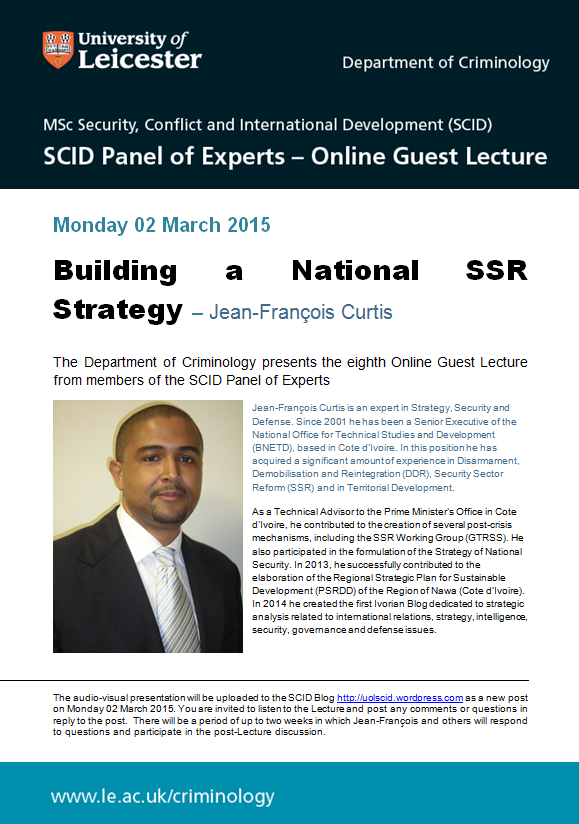
Jean-Francois Curtis Advert - imageThe lecture engages with the issue of building a national SSR strategy based on the Ivorian example, specifically addressing the major definitions of SSR, the historical background of the crisis in Côte d’Ivoire, the description of the SSR strategy that was carried out and finally the lessons learned from that SSR process.

The idea is to share the weaknesses and strengths of the Ivorian ongoing experience with SSR and provide lessons that could be useful for SSR programmes being implemented in other post-conflict environments. There are multiple examples of SSR strategies in many contexts and this lecture does not aim to fulfil the impossible task of covering all the issues and problems related to SSR. Instead the lecture gives an insight of what implementing an SSR strategy in an African French-speaking country is like.

Click on the link below to access Jean-François’ Lecture (it is large so it will take a while to download). Please submit any questions or comments within the next two weeks for Jean-François’ attention and/or discussion by other SCID Panel members, students and staff.

BUILDING A NATIONAL SSR STRATEGY – JF CURTIS

On Liberty

https://soundcloud.com/criminology-uni-of-leics/shami-chakrabarti-liberty Shami Chakrabarti – who has been Director of Liberty (The National Council for Civil Liberties) since September 2003, the UK’s leading civil rights organisation – gave the most recent Scarman Lecture at the Department of Criminology, University of Leicester. Shami ChakrabartiIn On Liberty, Shami Chakrabarti explores why our fundamental rights and freedoms are indispensable. She shows, too, the unprecedented pressures those rights are under today. Drawing on her own work in high-profile campaigns, from privacy laws to anti-terror legislation, Chakrabarti shows the threats to our democratic institutions and why our rights are paramount in upholding democracy. Other Scarman Lectures can be accessed on the Department’s website.

IS and the barbarism of war

An excellent article which puts the violence of IS into context.

richardjacksonterrorismblog's avatarJust trying to stay human...

The following is an op-ed I recently published in the Otago Daily Times about the barbarism of ISIS and how we might put it in context:

The latest atrocity by Islamic State forces in Iraq in which a captured Jordanian pilot was burned to death has provoked an understandable wave of commentary from around the world. The horrific spectacle created by the killing raises a number of crucial questions for us to consider. Is Islamic State (IS) a new, more brutal kind of rebel group? What purpose can such brutality serve? How should the world respond to the increasing brutality of the war in Iraq, and what does this latest development tell us about Western strategy in the region?

Sadly, this atrocity, and those previously committed by IS, are actually fairly banal in the history of warfare. Depraved cruelty and inhumanity is part and parcel of the very nature of…

View original post 397 more words

Working and Studying in the Field

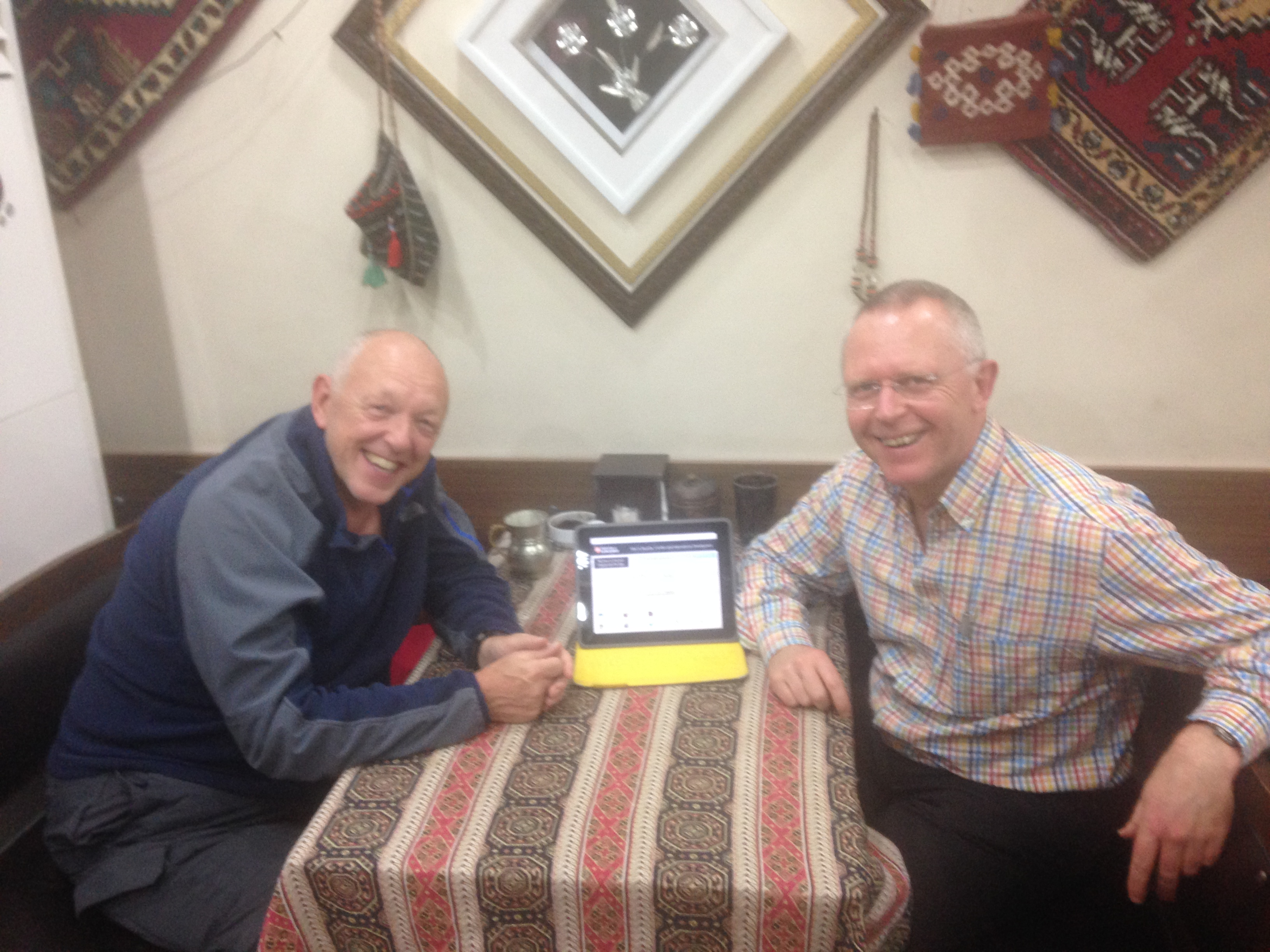
This is a fantastic picture and an example of excellent working relationships between students and dissertation supervisors, which is a key feature of the SCID Course. Peter Aschenbrenner is currently completing his MSc SCID dissertation. Lenny Gill is his supervisor and is also a member of the SCID Panel of Experts. They have maintained regular contact with each other throughout the dissertation process, while both deployed to conflict-affected environments. By chance they had an opportunity to meet while on business in Istanbul, and below is a picture of their face-to-face tutorial. Thank you for the outstanding support and guidance you have provided to Peter throughout the dissertation process, Lenny, and very well done Peter for the amount of work you have done often in challenging circumstances – I am very much looking forward to reading your dissertation!

Lenny and Peter - SCID

Language, War and Peace

This post by Phil Vernon of International Alert – The anti-lexicon of peacebuilding: listening to Edward Saïd and George Orwell – raises some excellent points about the need for language to be clear in the field of peacebuilding (and elsewhere) to avoid ‘misunderstandings and misdiagnoses’.

It is agreed that in order for conflict resolution and peacebuilding efforts to be successful, regularly used concepts need to be unpacked and each enjoy a shared, specific and clear meaning. Without a shared understanding of such concepts it is hard for action to be co-ordinated, coherent, efficient and effective. It is also hard to monitor and evaluate progress, identify and utilise lessons learned and best practice, and ultimately improve efforts to prevent and respond to conflict and its challenges. Actions and outputs are less likely to be ambiguous, conflicting and ineffective if communication is clear and the language used to describe aims and outputs is shared and unambiguous.

However, aims and outputs of various actors in conflict-affected environments are not always harmonious, and a shared – if ambiguous – language can be used (and often is) to disguise competing agendas and real priorities. The language of peacebuilding can often be used by those engaged in this field to disguise the politics of intervention. It can also be used to reinforce power relations within the field, which tend to marginalise ‘other’ voices – including those directly affected by conflict and those whose future’s most depend upon the success of peacebuilding.

It is also important to recognise the policy implications of certain concepts and understand the reasons why certain concepts are ascribed to certain phenomena, states or processes above others. As the beginning of the SCID Course addresses, describing a state as failed or fragile may be motivated more out of a desire on the part of other states to intervene (and control threats, or extend their own influence and power, or distract domestic populations from other issues/other threats), rather than ‘concern for the inability of some states to provide for their own population’s security, welfare and rights’ (Call, 2008: 1504). Similarly, describing governance as ‘weak’ may be unhelpful insofar as it often overlooks informal systems of governance and insofar as it is often used as shorthand (and thus specific details or supporting evidence need not be provided). However, it is precisely this value – overlooking the specificities of each system of governance – that makes the term ‘weak governance’ so useful, and tends to generate similar policy responses.

It is suggested that it is necessary to recognise the complexity, power and political dimensions of language – and the ways that it can be used to reinforce or challenge power relations; legitimise actions and intervention; and rationalise, exploit or hide competing agendas. Perhaps we need to accept that the language used in peacebuilding – as elsewhere – can be ambiguous with the same concept being used to mean different things by different people, for instance – just as peace and conflict are experience and mean different things to different people. Rather than aiming to be objective and specific in our use of language, perhaps we need to accept that language is a social construct: it is as part of conflict and peace as it is the tool used to understand these phenomena; it is a means through which conflicts are fought, and peace is forged; it reinforces or shifts power relations and as such is at the heart of conflict. It is informed by our specific experiences as well as shared histories and cultures, as much as it reflects our aspirations and intentions (whether at the micro or macro level). It is suggested that there can be no objectivity when it comes to the language we use: what is important is that we become aware of our subjectivity and how it is reflected in the language we use. In that way we can start to accept the legitimacy of ‘other’ perspectives as well as start to question the validity of metanarratives about conflict and peace – and in such a way potentially better contribute to building more peaceful societies (however we might define them).

Eleanor

Reference: Call, C. (2008) ‘The Fallacy of the “Failed State”’, Third World Quarterly, 28(8): 1491-1507.

Phil Vernon's avatarPhil Vernon

I think Edward Saïd wrote somewhere that the USA can never hope to contribute to sustainable peace in the Middle East until it is willing and able to describe the situation there objectively, comprehensively and accurately. Good advice for President Obama and his new Secretary of State as they embark on four challenging years in the region. And good advice meanwhile for anyone, be they doctor, secretary of state, international NGO staff member or anyone else, who takes on responsibility to help others fix their problems.

George Orwell, in his 1940s essay, Politics and the English Language (downloadable freely through Google), developed six golden rules for writing clearly about politics:

1. Never use a metaphor, simile, or other figure of speech which you are used to seeing in print.

2. Never use a long word where a short one will do.

3. If it is possible to cut…

View original post 1,207 more words

Capital, the State and War: The Risks of Method

This is a re-blog of an excellent discussion by Campbell Craig of Alex Anievas’ new book, Capital, the State and War (2014). This book builds upon Kenneth Waltz’s 1959 publication of the same name, which aims to explore the recurrence of war; looking beyond reasons of human nature and regime type, which were considered to be inadequate explanations alone. Anjevas builds upon the Marxian theory of uneven and combined development to theorise contemporary international relations. This theory was developed by Trotsky to explain how uneven economic competition between counties whose economies are intertwined leads to interstate conflict. Craig provides a detailed analysis of the relevance of Anievas’ wok in explaining the ‘thirty year crisis’ of 1915-45. He draws attention, however, to the weaknesses of the theory of uneven and combined development in explaining international relations post ’45.While, however, as Craig argues, ‘there has been no war among major capitalist powers’ since the end of WW2 there have, of course, been various intrastate wars where the interests and agendas of major capitalist countries have been – and continue to be – played out.

Eleanor

Guest Authors's avatarThe Disorder Of Things

CraigA forum contribution from Campbell Craig, the first in our series responding to Alex Anievas’ new book, Capital, the State and War. Campbell is Professor in International Politics at Aberystwyth University, and the author of several books, including Glimmer of a New Leviathan: Total War in the thought of Niebuhr, Morgenthau and Waltz (2003), The Atomic Bomb and the Origins of the Cold War (2008, with Sergey Radchenko), and more recently America’s Cold War: the Politics of Insecurity (2012, with Fredrik Logevall). Campbell’s work has appeared in World Politics, Ethics & International Affairs and the Review of International Studies. He is also currently finishing an article on the nuclear revolution and neo-Trotskyism.


Woodrow Wilson 17c Stamp

In 1959 Kenneth Waltz published Man, the State and War, a study of three different levels of analysing international relations and their attempts to answer the question why war recurs. Waltz tackled his…

View original post 1,887 more words

Online Seminars in Peacebuilding and Statebuilding

The Centre for Security Governance (CSG), Balsillie School of International Affairs (BSIA), and Wilfrid Laurier University Global Studies department (WLU) are hosting a series of eight online seminars focusing on the theme of “Contemporary Debates on Peacebuilding and Statebuilding.”

The first event, to be held on Wednesday January 28 from 1:00PM to 2:30PM EST will ask the question: “Is Peacebuilding Dying?”

These events will be free to attend and open to the public. They will be held on the Spreecast platform, and will feature live panel presentations and an open discussion period where you can interact with the panelists. Panelists for the first session include Dr Paul Jackson, Dr Mark Sedra, Dr Roger Mac Ginty, Dr Anna Jarstad.

For further details and to access the seminar, please visit CGS’s website.

Conflict Predictions 2015

The President of the International Crisis Group (ICG), Jean-Marie Guéhenno, has recently published ’10 Wars to Watch in 2015′ – the organisation’s annual look at likely crises in the coming year – in Foreign Policy, available at this link and available on the ICG website here. The 10 conflicts and crises identified as likely to be the most dangerous in 2015 are:

  1. Syria, Iraq, and the Islamic State
  2. Ukraine
  3. South Sudan
  4. Nigeria
  5. Somalia
  6. Democratic Republic of Congo (DRC)
  7. Afghanistan
  8. Yemen
  9. Libya and the Sahel
  10. Venezuela

CFR Global Conflict TrackerThe Council for Foreign Relations (CFR) has also recently published the results of a public opinion survey conducted in the US on conflicts that could erupt or escalate in the coming year: the report and an overview can be accessed here and an interactive guide to US conflict prevention priorities can be accessed here.

At the start of the SCID Course, when considering conflict prevention and the causes of conflict, students are asked to identify place where they think conflict may arise or escalate in the next 12 months – these predictions are returned to later in the course. Reflecting on recent conflicts and conflict predictions can help in the analysis of conflict trends and dynamics, as well as present potential conflict prevention and peacebuilding opportunities. As Guéhenno concludes his reflection of the conflicts in 2014 and predictions for 2015:

The picture that emerges from this survey of conflicts is grim. There is, however, one glimmer of hope — the increasing fragmentation of the world also means that there is no overarching divide. Even if the deepening crisis between Russia and the West is unsettling Europe, the last remnants of the Cold War are disappearing as Cuba and the United States normalize their relations. Many conflicts can now be dealt with on their own merits, and the growing role of regional powers — while adding complexity and, in some cases, new antagonisms — also creates opportunities for more creative diplomacy.

This is no time for the “old powers” to retrench, but they do have to acknowledge that successful peacemaking in 2015 will depend on working with a much broader array of countries than they have in the past (Guéhenno, 2014: n.p.).

Despite the availability in the public domain of many such predictions and tools to help analyse where conflict might erupt or escalate, there is often surprise at the outbreak of new conflicts and crises. Similarly, despite the many tools that do exist to help determine where conflict, violence or insecurity may erupt or escalate, conflict prevention rarely appears to be a priority – in spite of the obvious human and financial benefits of preventing conflict. Some of the tools and resources are linked to in the SCID Course materials and copied below. There are many insightful reflections on the causes of conflict and conflict prevention in the SCID discussion boards – the value of them often lies in their specificity and being informed by in-depth experience in and understanding of a particular region or place. As those engaged in peacebuilding begin to increasingly value the role of local communities in building peace, at least in theory, a community-based bottom-up approach to conflict prevention might also be worth considering (utilising existing local peace committees e.g.) – informed by but not limited to some of the predominantly quantitative data contained in the resources listed below.

  • Heidelberg Institute’s Annual ‘Conflict Barometer’ – available here.
  • Vision of Humanity’s ‘Global Peace Index’ – available here.
  • The World Bank’s Worldwide Governance Indicators – available here.
  • The Fund for Peace’s Fragile States Index – available here.
  • The UN Development Programme’s (UNDP) Human Development Index (HDI) – available here.
  • The biennial publication of the Center for International Development and Conflict Management (CIDCM) of the University of Maryland, ‘Peace and Conflict’ – available here.
  • The Minorities at Risk (MAR) project at the University of Maryland’s CIDCM – available here.
  • Datasets of the Uppsala Conflict Data Project (UCDP) of the Department of Peace and Conflict Research of Uppsala University, Sweden – available here.
  • Stockholm International Peace Research Institute’s (SIPRI) Facts on International Relations and Security Trends (FIRST) system – available here.
  • The Organization for Economic Cooperation and Development’s (OECD) Country Risk Classification – available here.
  • The Cingranelli-Richards (CIRI) Human Rights Dataset – available here.
  • The University of North Carolina’s Political Terror Scale – available here.
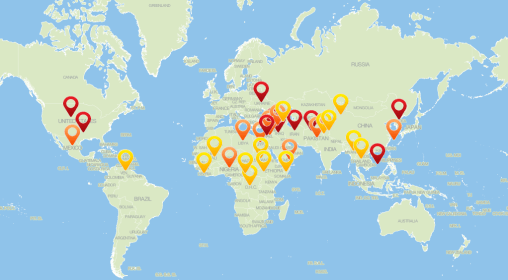
  • The International Crisis Group’s (ICG) monthly ‘Crisis Watch’ – available here. You can also access an interactive conflict risk alert map (below) –

I look forward to continue discussing the way in which conflict can be prevented from breaking out and escalating. Eleanor

ICG jan 15

SCID Panel of Experts – Online Guest Lecture – Douglas Brand OBE: The Case for Inter-Agency Co-operation in Peace Support Operations

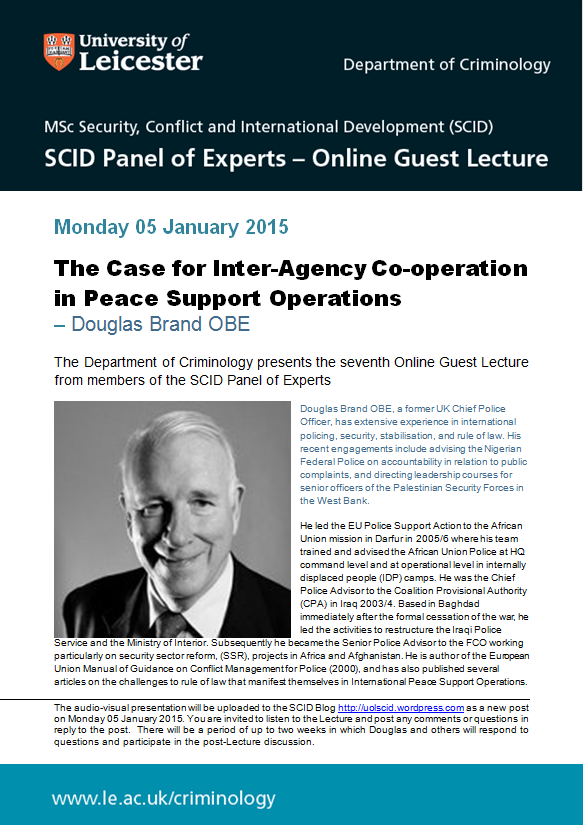
This is the 7th Online Guest Lecture by members of the SCID Panel of Experts. Douglas Brand OBE presents a lecture entitled ‘The Case for Inter-Agency Co-operation in Peace Support Operations’.

Douglas Brand Online Guest Lecture - advertThis lecture presents the case for inter-agency co-operation in Peace Support Operations (PSOs), particularly in light of the absence of willingness for co-operation despite general agreement that co-operation is necessary. The lecture considers impediments to successful co-operation and how co-operation can best be facilitated by looking at examples from Iraq, Darfur and Palestine and by reflecting upon lessons identified and lessons learned.

Click on the link below to access Douglas’ Lecture (it is large so it will take a while to download). Once you open the PowerPoint presentation, you will have to click on ‘Slide Show’ (at the top of the screen) then ‘From Beginning’ (top left) to listen to the presentation.

Please submit any questions or comments within the next two weeks for Douglas’ attention and/or discussion by other SCID Panel members, students and staff.

Douglas Brand – Inter Agency Activities in Peace Support Operations

2014 in review

The WordPress.com stats helper monkeys prepared a 2014 annual report for this blog.

Here’s an excerpt:

The busiest day of the year was March 31st with 90 views. The most popular post that day was SCID Panel of Experts Online Guest Lecture – Dr Tony Welch OBE – Introduction to SSR, Human Security and UNSCR 1325.

Click here to see the complete report.